
This is an old revision of the document!
Archetypal Phases of the Design Process
Design processes can be structured very differently depending on the discipline, project, and task. Within the study program, we use the four archetypal phases Discover!, Ideate!, Make! and Expose! as a shared framework to structure different activities within a design process and to make the individual working process more transparent. These phases are explicitly not intended as a rigid or linear sequence, but as an iterative process in which individual steps overlap and may be repeated several times. Insights gained from experiments, prototypes, tests, feedback, or reflection can at any point lead to questioning earlier assumptions, conducting additional research, developing new ideas, or modifying existing concepts. The design process should therefore be understood less as a fixed sequence of individual steps and more as a repeated movement between understanding, developing, testing, and reflecting. In simplified form, this process can be described as Discover! → Ideate! → Make! → Expose!, while continuous loops of Make → Test → Reflect → Iterate ↺ occur especially during development and can lead back to earlier phases whenever necessary.
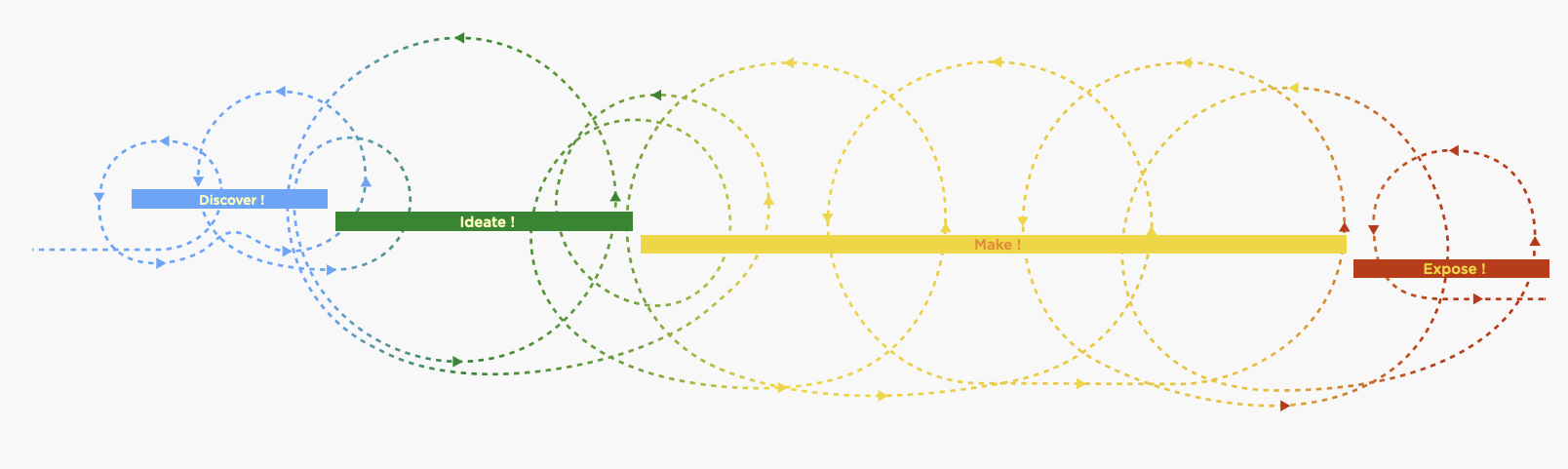
| Discover! Understand and contextualize | Ideate! Develop possibilities | Make! Make ideas visible and testable | Expose! Communicate process and result |
|
|---|---|---|---|---|
| Goal | Understand the task, context, needs, problems, and opportunities. | Develop different ideas and solution approaches and open up the solution space. | Develop selected ideas further, test them, and make them tangible and assessable. | Structure and communicate the design process and its results in a clear and understandable way. |
| Focus | Observe, research, analyze, identify relationships, and consolidate insights. | Explore, vary, combine, question, and select. | Develop, prototype, test, reflect, and iterate. | Select, document, present, explain, and reflect. |
| Possible methods | Research, observation, analysis, interviews, mapping, problem definition, design challenges | Brainstorming, brainwriting, mind mapping, sketches, storyboards, scenarios, simple models | Sketches, models, mock-ups, experiments, prototypes, scheme design, detailed design, testing | Presentation, documentation, critique, feedback, posters, process visualization |
| Result | A well-founded question or a clear starting point for the further process. | Different possible solution approaches and a reasoned selection for further development. | An increasingly concrete design or prototype that can be tested and developed further. | A comprehensible representation of how the initial question, process, and result have developed. |
| Iteration | New insights can at any time require additional research or a redefinition of the problem. | Insights from prototyping and testing can at any time trigger new ideas. | Make → Test → Reflect → Iterate ↺; return to Ideate! or Discover! if necessary. | Feedback and reflection can raise new questions and trigger another iteration. |